Coastal bluffs and seawalls in Southern California are under steady pressure from the ocean, and the 2026-27 winter is a good reason for owners, developers, general contractors and engineers to look closely at the top, face and toe of the bluff.
In its ENSO Diagnostic Discussion issued October 8, 2026, NOAA’s Climate Prediction Center stated that El Niño continues to strengthen, with a strong to very strong event likely through January to March 2027. NOAA added that impacts consistent with El Niño are more likely with an event of this magnitude, though not guaranteed. The California Coastal Commission expects El Niño to pick up during December through February, when coastal communities may see more frequent and intense storms, rainfall and high waves.
These forecasts describe probabilities, not outcomes for any individual bluff or property.
Why Coastal Bluffs and Seawalls Fail
Coastal bluffs are exposed from two directions. The U.S. Geological Survey notes that coastal cliffs are subject to wave action as well as precipitation-induced seepage, and that failures can occur at both the bottom and the top of a cliff.
Erosion at the toe is often the starting point. A USGS study of sea cliff erosion during the 1997-98 El Niño described wave attack as the process that removes debris and erodes the cliff base, increasing the slope of the cliff. USGS reports that cliff erosion rates vary with sea level, wave energy, coastal slope, beach width and height, and rock strength.
The Coastal Commission’s September 2026 El Niño memo notes that past strong El Niño winters combined elevated water levels, higher wave energy and shifts in wave direction to drive severe coastal erosion, and that the most damaging storms often coincide with the highest tides. It adds that low sand volumes and narrow beaches in places such as southern Orange County may leave coastal development especially vulnerable.
USGS also notes that cliffs can be stable for decades between large landslides that remove several feet of bluff top.
Warning Signs for Bluff-Top Properties
The Coastal Commission recommends inspecting seawalls and revetments for distress, loss of material and obstructed drainage, and inspecting bluff tops for instability or drainage problems. The California Geological Survey advises watching for new cracks, tilting trees, bulging at the base of slopes, new seeps and excess erosion. Conditions that may deserve attention include:
- New or widening cracks in soil, patios or hardscape near the bluff edge
- Fresh slumps, slides or fallen material on the bluff face
- Undercutting or notching at the toe of the bluff
- New seepage, springs or wet areas on the bluff face
- Cracking, tilting, settlement or missing material at a seawall or revetment
- Blocked drains or runoff flowing over the bluff edge
For a closer look at these conditions, see Signs of Slope Instability After Heavy Rain. Any of them warrants evaluation by a geotechnical engineer. If movement appears active, stay away from the bluff edge and base and contact local authorities.
How Coastal Bluff and Seawall Repair Is Done
There is no single repair system for every bluff. The engineered response depends on geology, depth of potential movement, condition of existing protection, nearby structures and access. Common methods include:
Shear Pins, Grade Beams and Tiebacks
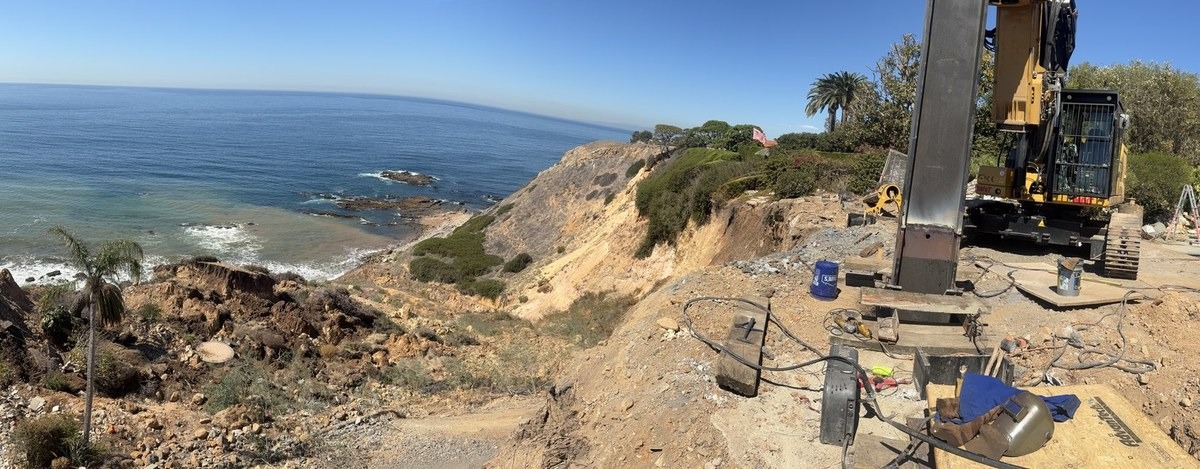
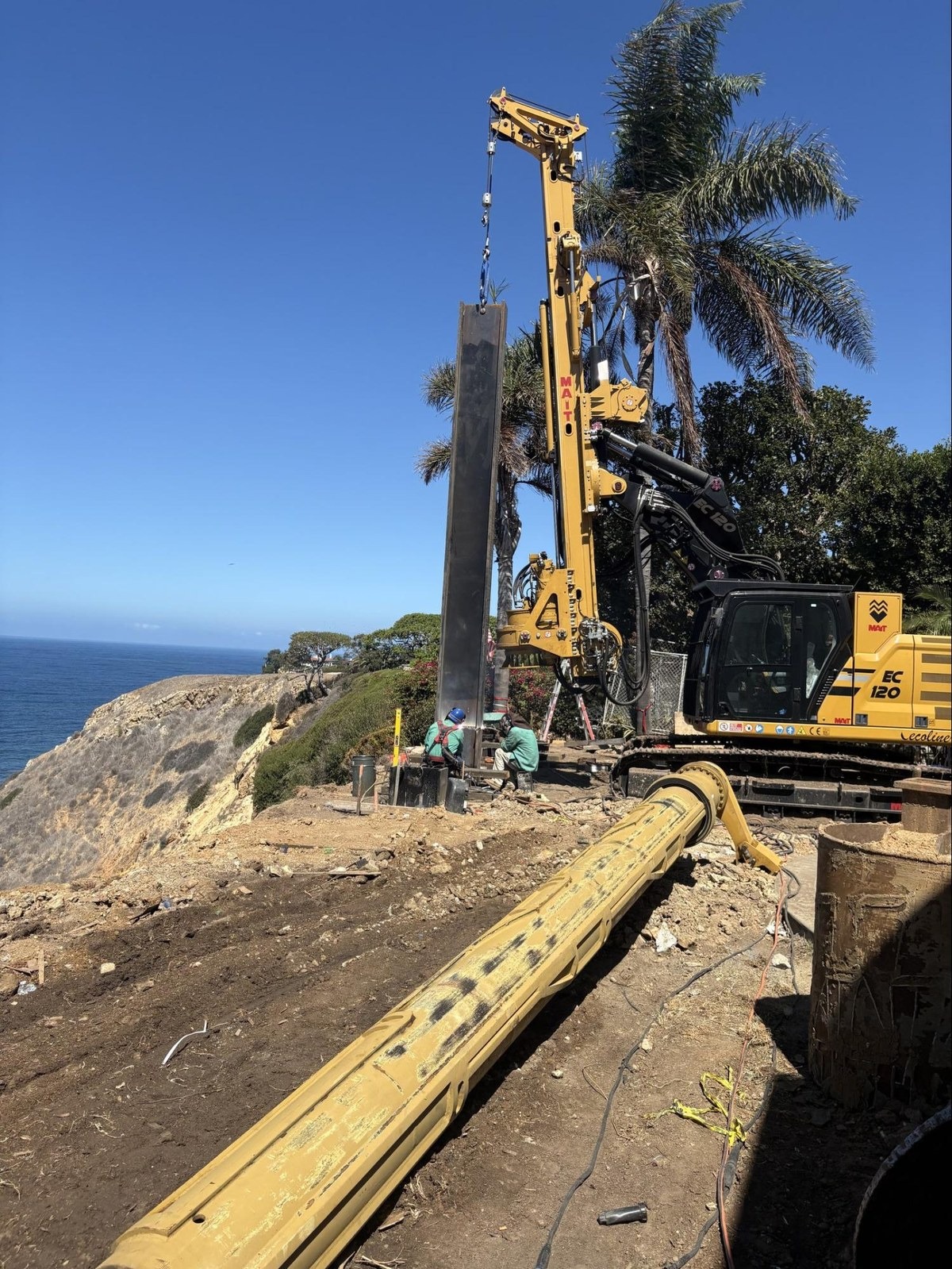
Shear pins are drilled, reinforced concrete piles designed to resist lateral soil movement. Grade beams tie the tops of the pins together, and tiebacks anchor the system into competent material. ADEI used this approach on an emergency bluff repair in Rancho Palos Verdes that included 17 shear pins, a grade beam and 17 tiebacks.
ADEI also used tiebacks and grade beams on the Casa Romantica project in San Clemente, where a failed coastal slope above an active rail corridor was stabilized and reconstructed with three levels of post-tensioned tiebacks integrated with reinforced concrete grade beams. On the Marquita slope repair, 21 shear pins and tiebacks helped stabilize a hillside above an active pump station and rail line.
Caissons and Lagging
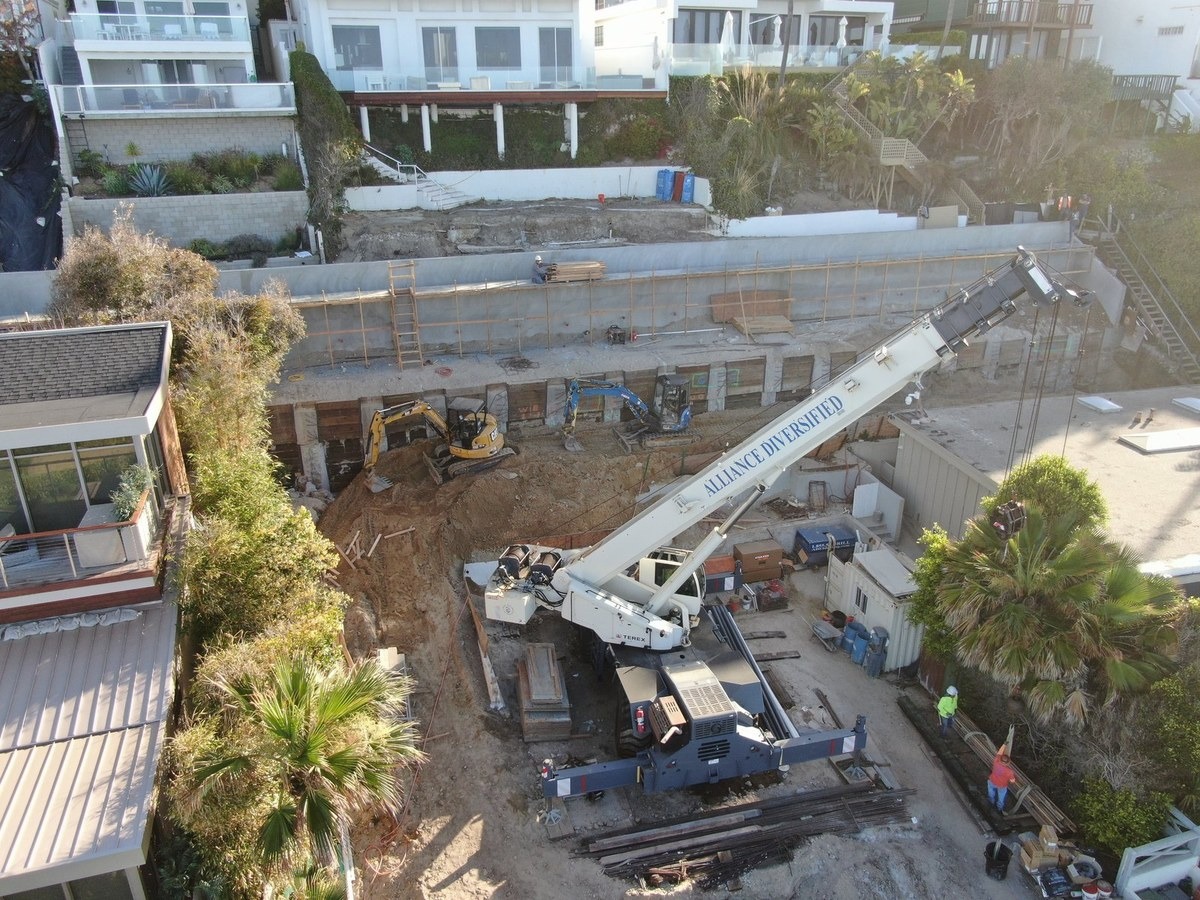
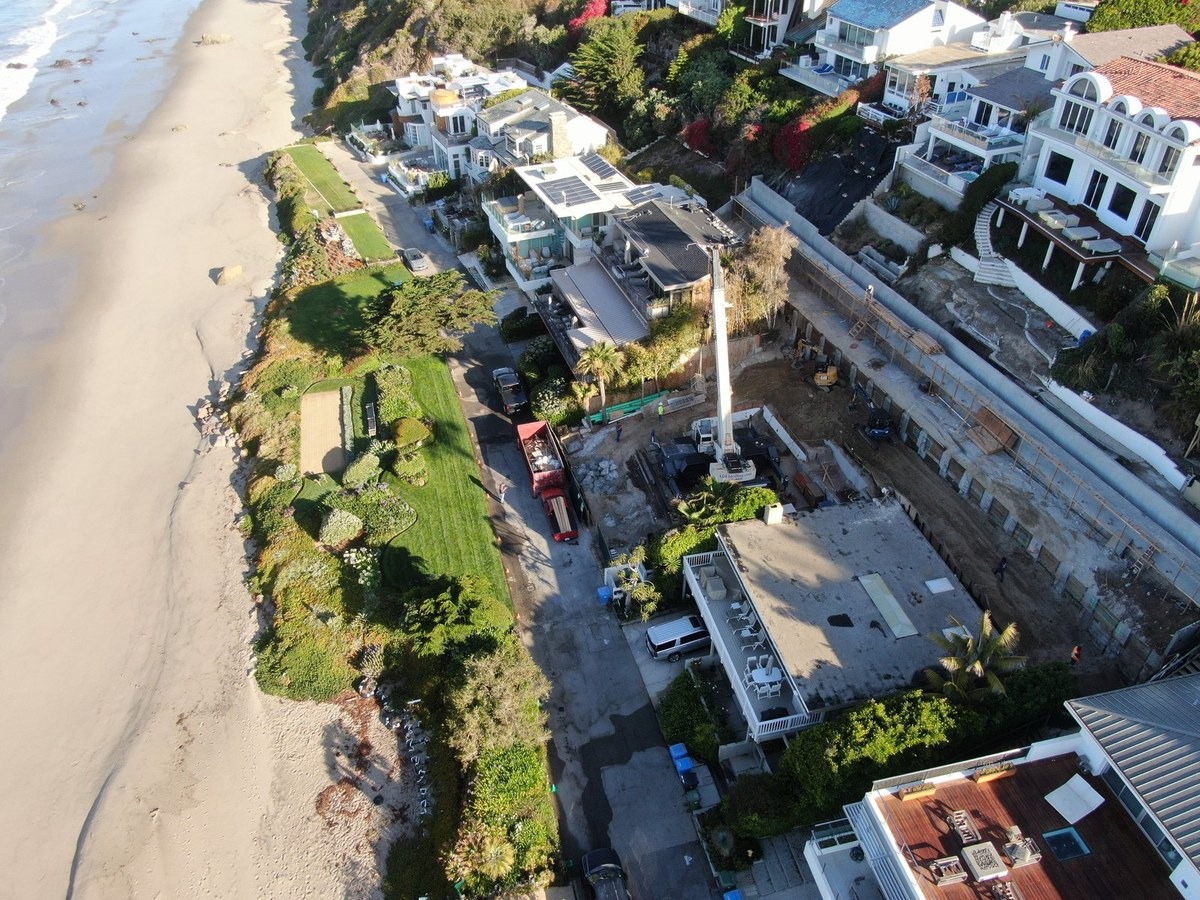
Drilled caissons with lagging between them can retain soil where excavation or protection is needed near the shoreline. ADEI has installed beachside caisson and lagging shoring in Malibu.
Soil Nails and Shotcrete
Reinforcing steel is drilled and grouted into the bluff face and combined with a shotcrete facing. In ADEI’s coastal work, soil nails and shotcrete are used mainly for cliff face stabilization and erosion protection rather than slope stabilization. Soil nails are generally not long enough to extend through a deeper failure surface, so where a bluff or slope needs to be stabilized, ADEI typically uses grade beams and tiebacks.
Why Limited Beach and Bluff Access Matters
Coastal repair work is often where equipment has the hardest time reaching: the toe of a bluff, a narrow beach or a slope below an existing structure. Tides, sand levels, homes, public beach use and rail corridors can all limit what can be brought in and when. The Coastal Commission notes that using mechanized equipment on the beach or near a bluff can require a coastal development permit.
Portable and limited-access drilling equipment allows certain work to be performed from the bluff top or in tight areas where conventional rigs cannot go. Planning access early helps the team understand what can be built, from where and when.
Why Early Repair Costs Less Than Emergency Work
Bluff repair is expensive at any stage, but timing affects cost and options. Planned work can be investigated, designed, permitted and sequenced around tides, weather and access. Emergency work typically happens on compressed schedules, in difficult conditions and with fewer choices.
The Coastal Commission’s memo explains that permanent solutions such as slope reconstruction, retaining walls and seawalls almost always require a coastal development permit, and that a perceived threat from upcoming storms is generally not considered an emergency. Emergency permits authorize only the minimum temporary work needed, and keeping that work requires a follow-up regular permit. The Governor’s September 21, 2026 emergency proclamation directs the Commission to act on urgent emergency requests within 24 hours, but that authorization is still temporary.
Starting evaluation, design and permitting early generally gives owners and project teams more control over scope, schedule and cost.
Preparing Coastal Properties for the 2026-27 Winter
What the current outlook does provide is a reason for contractors, developers and property owners working around slopes to remain aware of changing site conditions as the rainy season develops.
If movement, erosion, seepage or other changes become visible, the appropriate engineering and geotechnical professionals should evaluate the condition and determine what action, if any, is required.
When an engineered project requires specialty drilling, earth retention or slope stabilization construction, ADEI has the equipment, engineering and field capabilities to work on complex and limited-access sites throughout Southern California.